
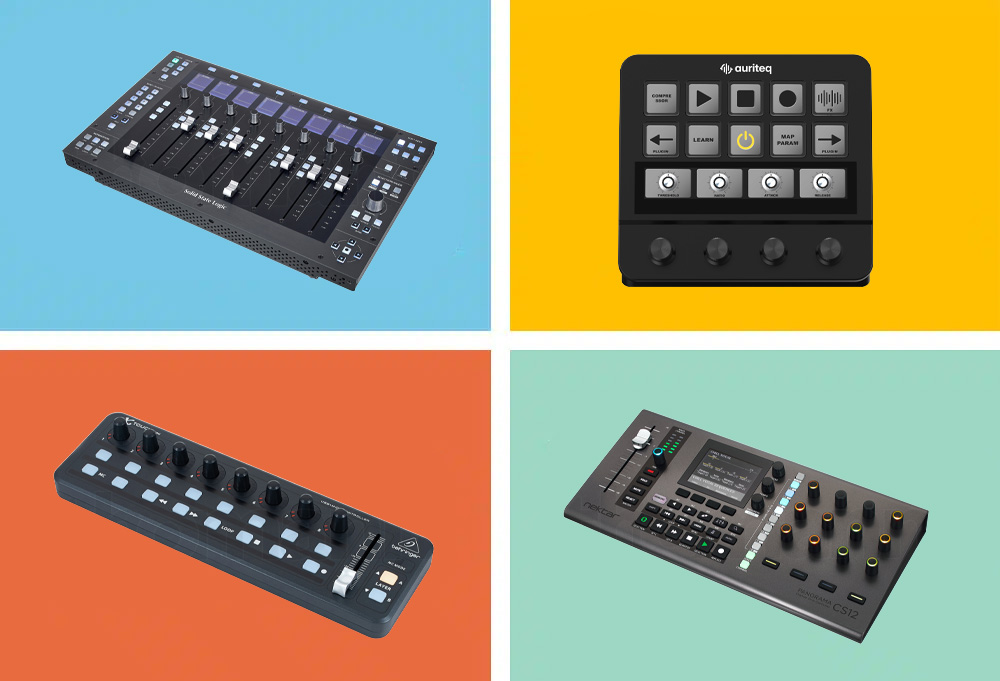
Logic Pro supports the Mackie Control Protocol (MCU), the HUI protocol, and also has its own interfaces for third-party scripts. This means: Most professional controllers work with Logic — but not all equally well. In this guide, we'll look at the 9 best controllers for Logic Pro 2026, from compact budget solutions to professional mixing consoles.
What to look for when buying a Logic Pro controller
Before we dive into the individual models, here are the most important criteria you should keep in mind:
- Logic Pro Integration: Some controllers offer dedicated Logic Pro scripts with deep integration — transport, mixer, smart controls, and plugin parameters are immediately accessible. Others use the universal Mackie Control Protocol (MCU), which works but is less deep. The more native the integration, the smoother the workflow.
- Fader vs. Encoder: Motorized faders move automatically with your project and show you the current position at any time. Encoders are cheaper and more compact but don't offer visual feedback on the fader position. For serious mixing, motorized faders are a real upgrade.
- Keyboard or pure controller? If you want to play melodies and chords, you need a MIDI keyboard. If you're primarily mixing and controlling plugin parameters, a pure controller is better — and saves space on the desk.
- Display: A display on the controller shows parameter names, channel names, and values directly on the knob. This saves constantly looking at the monitor and speeds up work enormously.
- Expandability: Some controllers can be paired with expansion modules — from 8 to 16 or even 32 channels. If you regularly mix large sessions, you should pay attention to this.
- Budget: From €65 to over €1,000, everything is included. The good news: Even in the lower price segment, there are controllers that noticeably improve the workflow.
The 9 Best Controllers for Logic Pro 2026 at a Glance
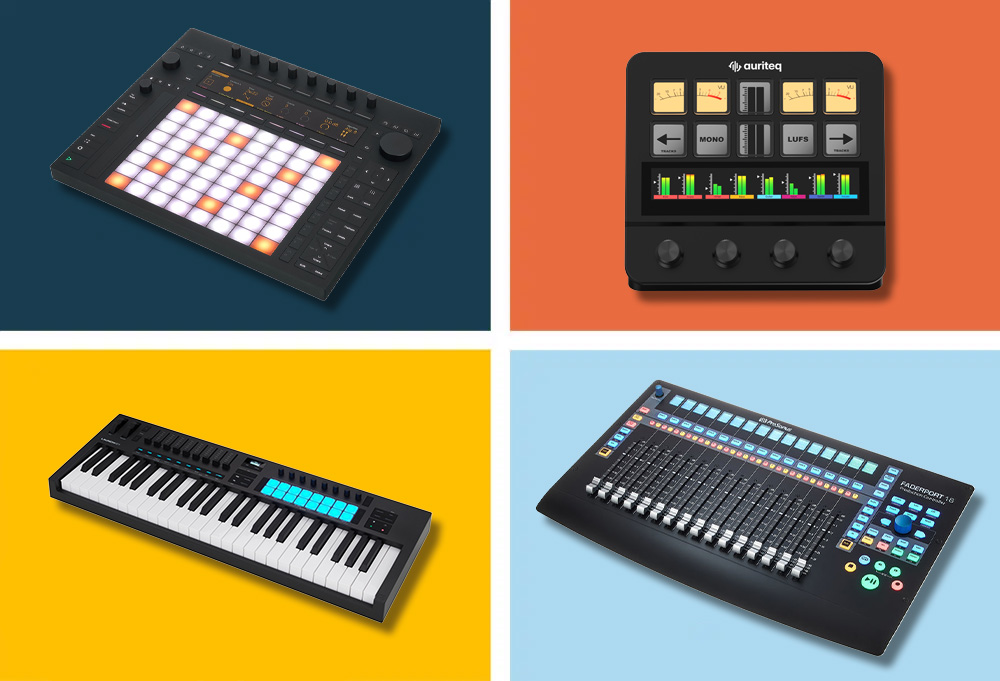
1. Auriteq Flow — Best for Plugin Control and Mixing
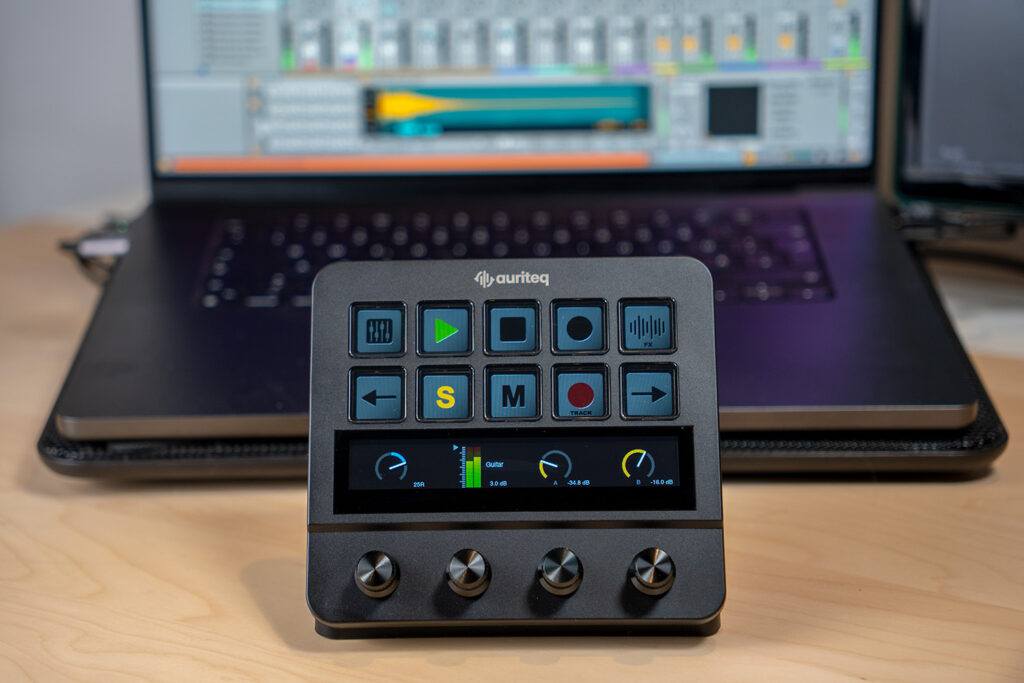
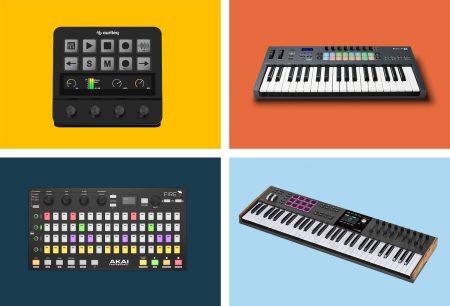
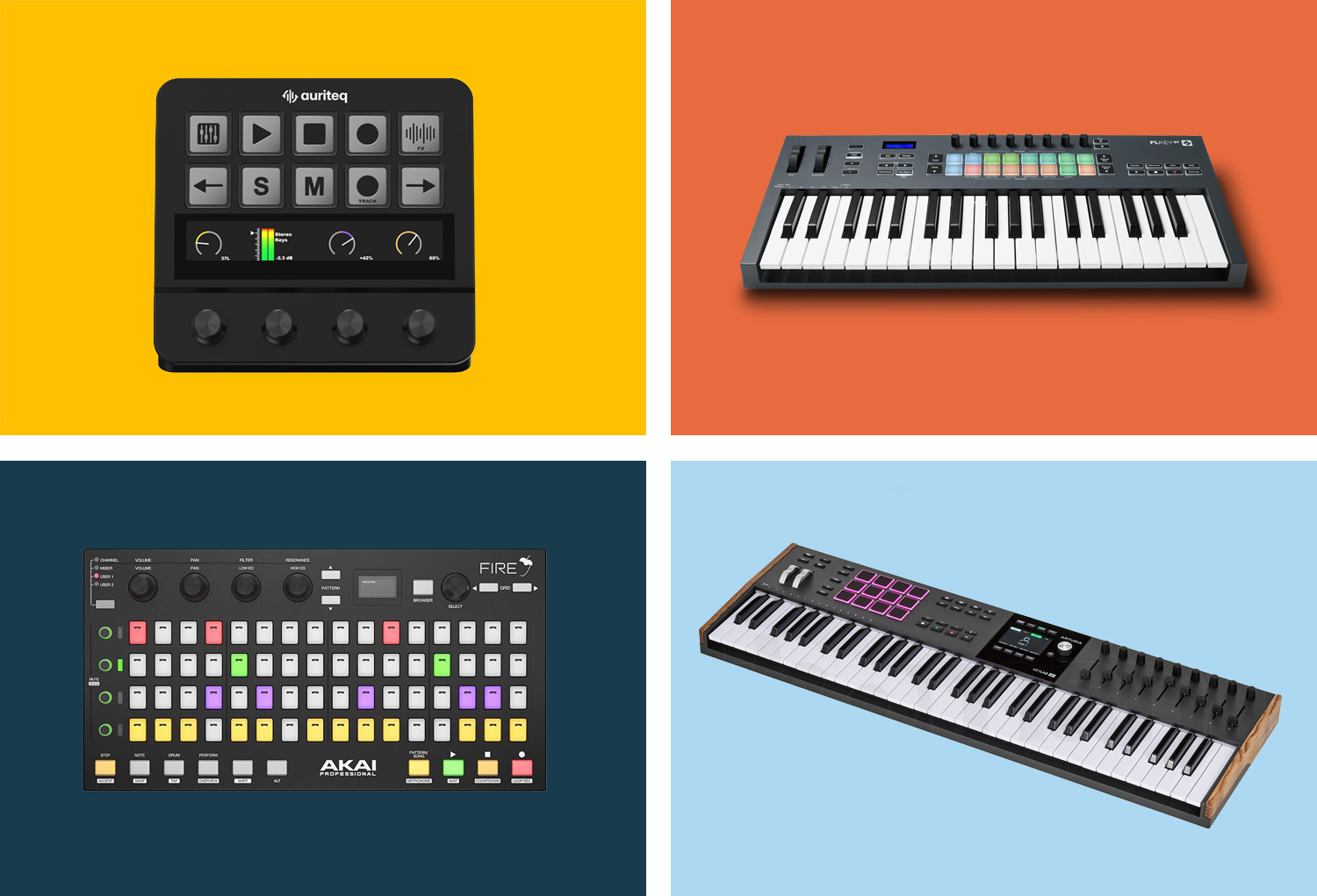
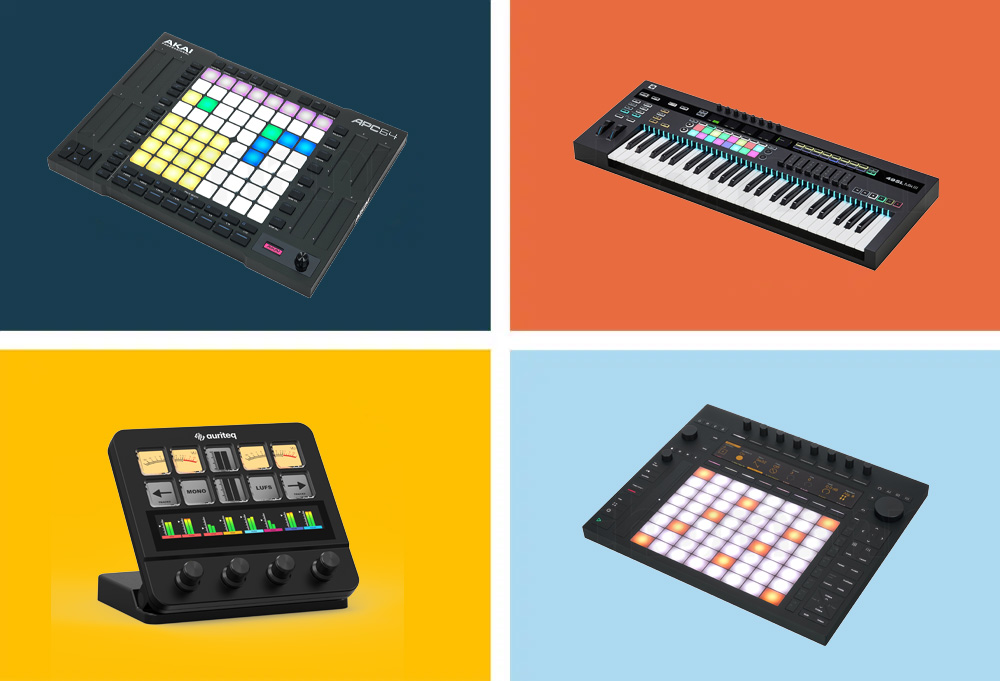
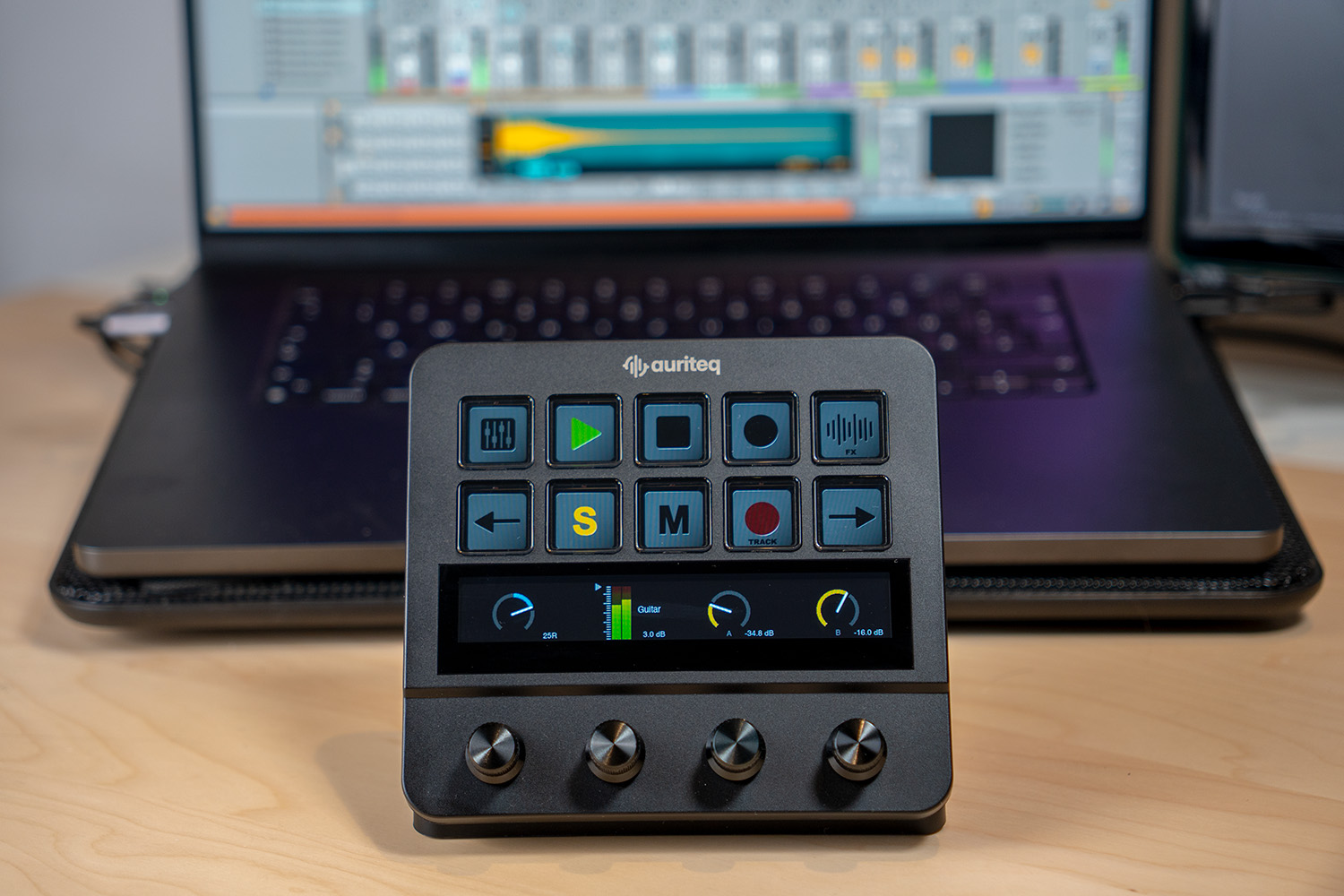
The Auriteq Flow is a relatively new player on the market that has quickly positioned itself as a serious addition to the Logic Pro setup. The concept: A compact desktop controller with a touchscreen, physical rotary knobs, and dynamic LCD buttons that sits seamlessly between you and your DAW — making the mouse completely unnecessary in many situations.
What sets the Flow apart from other controllers is the type of plugin integration. Where other controllers require tedious MIDI mapping or at best support the DAW's own instruments, the Flow automatically recognizes plugins — whether Alchemy, Retro Synth, FabFilter, Valhalla, Soundtoys, or Kontakt. You open a plugin, the parameters appear on the touchscreen, and the physical knobs are immediately assigned. No setup, no MIDI learn, no configuration.
In addition, there's a feature that surprisingly saves a lot of time in everyday life: Plugins, effects, and complete chains can be loaded and saved directly from the controller. Combined with the integrated LUFS metering (including VU meter, short-term loudness, dynamic range) and the 8-track mixer view with real-time level displays, you practically have a small mixing console on your desk. For Logic Pro producers who work a lot with third-party plugins and want to control their mix directly on the controller, there's currently nothing comparable in this price range.
TECHNICAL SPECS
Manufacturer: Auriteq
Controls: 10 dynamic LCD buttons, touch bar, 4 pressure-sensitive rotary knobs
Display: Touchscreen with real-time metering and plugin display
Metering: LUFS, VU, RMS, Dynamic Range (via included VST/AU plugin)
Mixer: 8-track mixer with level indicators directly on the display
USB Hub: 2x USB-3, 2x USB-C integrated
DAW Support: Logic Pro, Ableton Live, FL Studio (native integration)
Connection: USB-C
Colors: Black, White
Price: approx. 179€ (Launch offer, regular 199€)
ARGUMENTS IN FAVOR
- Automatic plugin mapping — works immediately with Logic's own and third-party plugins, no setup
- Touchscreen shows plugin parameters, metering, and mixer view in real-time
- Integrated LUFS metering at a professional level — no separate plugin needed
- Load and save plugins, instruments, and complete chains at the touch of a button
- Create your own mappings in under 5 seconds
- Integrated USB hub tidies up the desk
- Solid build quality — feels like professional equipment
- Also usable as a macro controller outside the DAW (shortcuts for Final Cut, Photoshop, etc.)
NEGATIVE POINTS
- Takes a bit of time to get used to all the scenes and functions — but after about 2 hours, you've got it
WHO IS IT SUITABLE FOR?
For producers and mix engineers who work a lot with plugins and want to noticeably speed up their workflow. Particularly interesting for anyone who knows the feeling that the DAW stands between them and the music. The Flow brings back tactile, direct working — without having to learn a completely new operating concept. For the price of under 200€, a pretty convincing overall package. (Our full review)
2. Novation Launchkey MK4 (49 Keys) — Best All-Rounder
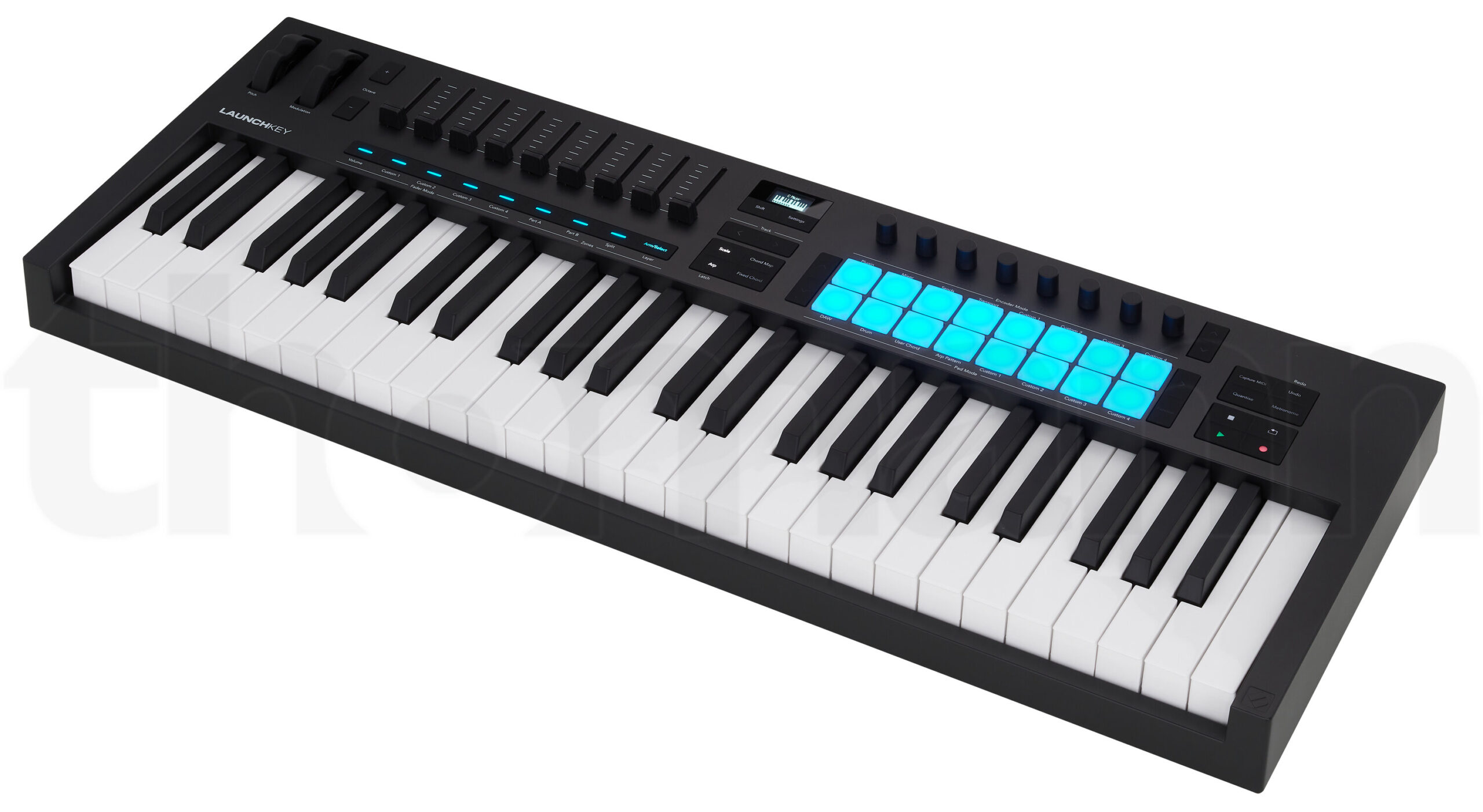
The Novation Launchkey MK4 is one of the most popular MIDI controllers on the market — and rightly so. In its fourth generation, Novation has completely redesigned the device, creating something that offers an incredible amount for both beginners and experienced producers. 49 semi-weighted keys, 16 velocity-sensitive RGB pads, 9 faders, 8 rotary knobs, and an OLED display — all in one device.
For Logic Pro users, the Launchkey MK4 is particularly interesting because Novation provides dedicated Logic scripts. Transport, mixer, smart controls — everything works immediately after plugging in, without having to configure anything. The faders can be directly assigned to the Logic mixer, the encoders control plugin parameters, and the pads trigger drums or launch clips. The OLED display shows parameter names, so you always know which knob is controlling what.
In addition, there are creative features like 30 scale modes, chord modes, and a generative arpeggiator that work excellently for songwriting in Logic. The included software bundle is generous: Ableton Live Lite, Cubase LE, and plugins from Klevgrand, GForce, Native Instruments, and Orchestral Tools. For around €219, you get a real all-rounder that combines keys, pads, faders, and encoders in one device.
TECHNICAL SPECS
Manufacturer: Novation
Keys: 49 semi-weighted waterfall keys
Pads: 16 velocity-sensitive RGB pads
Fader: 9 faders
Encoder: 8 rotary knobs
Display: OLED display for real-time feedback
Connection: USB-C (bus-powered)
Included Software: Ableton Live Lite, Cubase LE, Novation Play, plugins from Klevgrand, GForce, Native Instruments, and Orchestral Tools
Price: approx. 219€
ARGUMENTS IN FAVOR
- Dedicated Logic Pro scripts — transport, mixer, and smart controls immediately accessible
- Creative chord and scale modes built-in — perfect for songwriting in Logic
- Generative arpeggiator for quick inspiration
- 9 faders + 8 encoders = maximum control over the mix
- OLED display shows parameter names and current values
- Large software bundle included
- Excellent price-performance ratio
NEGATIVE POINTS
- Not the best choice if you need weighted keys for piano playing
- Takes up relatively much space on the desk
- Faders are not motorized — positions jump when switching banks
WHO IS IT SUITABLE FOR?
The Launchkey MK4 is perfect for Logic Pro producers looking for an all-in-one controller — MIDI keyboard, pad controller, and mix control in one device. Highly recommended if you need keys, pads, and faders and don't want to set up multiple separate devices.
Link: Thomann
3. SSL UF8 — Best premium controller for mixing
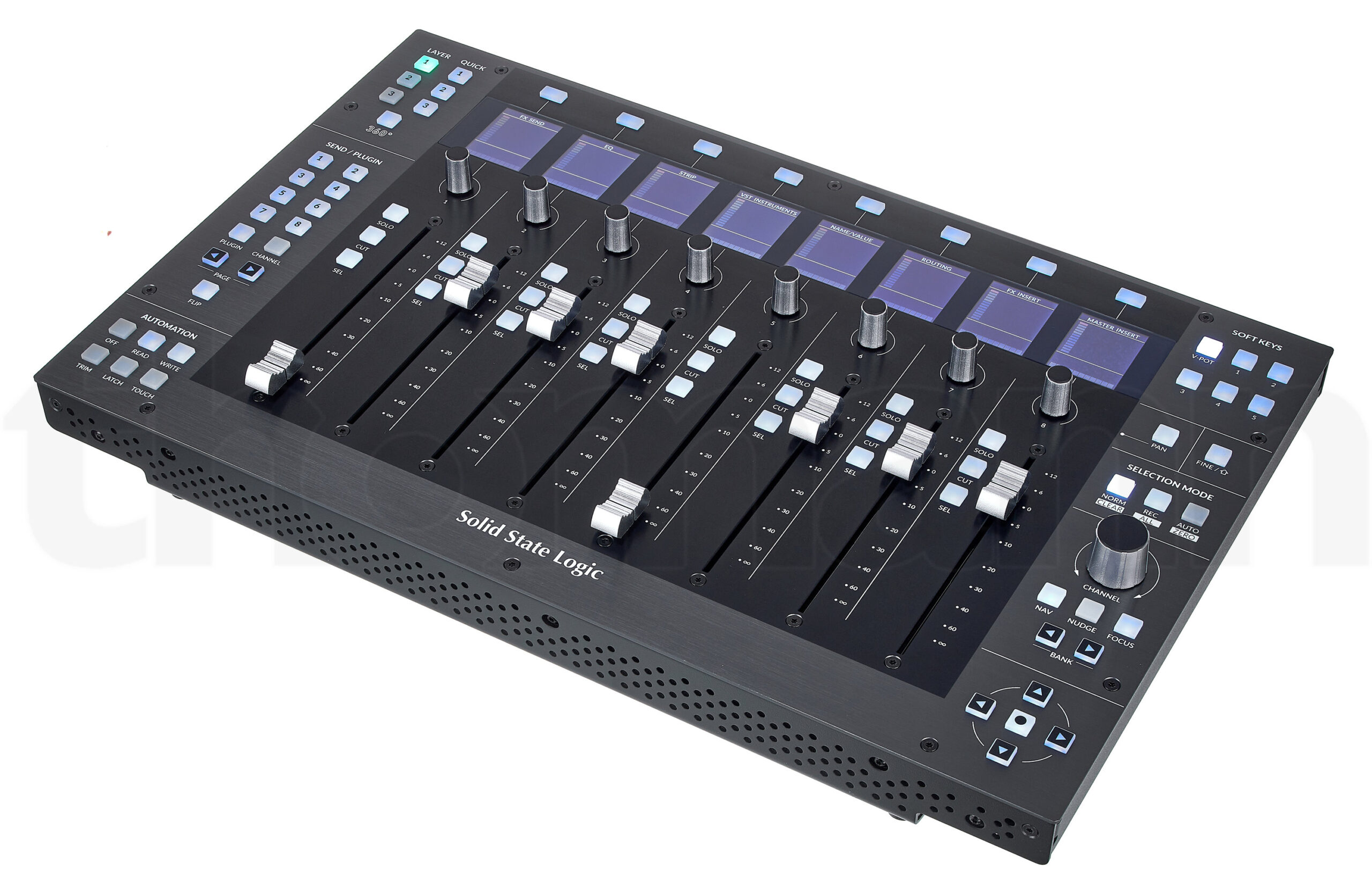
The SSL UF8 is what happens when a legendary console manufacturer builds a DAW controller. Solid State Logic brings decades of mixing experience, and you can feel it in every detail of the UF8. 8 motorized, touch-sensitive 100mm faders, high-resolution OLED displays above each channel, and a build quality that justifies the price of around €1,099.
For Logic Pro users, SSL offers a dedicated Logic layer that works immediately after plugging in. Transport, mixer, automation — everything is directly accessible via the controller. The faders automatically move with the project, creating a completely different experience than static faders when mixing. Particularly handy: The channel encoder allows you to hover over any plugin parameter with the mouse pointer and then turn it on the controller — an elegant solution that requires no MIDI mapping.
The UF8 can be expanded with up to three additional units — from 8 to 32 channels. Those who regularly mix large sessions with many tracks will find a professional tool here that truly makes the leap from mouse to physical console noticeable. The price is high, but for serious mixing, there's little that can match this device.
TECHNICAL SPECS
Manufacturer: Solid State Logic (SSL)
Fader: 8x 100mm motorized, touch-sensitive faders
Encoder: 8 V-Pots (rotary knobs) + 1 channel encoder
Display: High-resolution OLED displays above each channel
Buttons: Solo, cut, select, soft key per channel + transport section
DAW Support: Logic Pro, Pro Tools, Ableton Live, Cubase, Studio One (dedicated layers)
Expandable: Up to 4 units can be cascaded (32 channels)
Connection: USB-C, Ethernet (for daisy-chaining)
Price: approx. €1,099
ARGUMENTS IN FAVOR
- Motorized, touch-sensitive faders of SSL quality — the mixing experience is top-notch
- Dedicated Logic Pro layer with immediate integration
- OLED displays above each channel show channel names, levels, and parameters
- Channel encoder for plugin control via mouse hover — no mapping needed
- Up to 4 units can be cascaded for large sessions
- SSL build quality — feels like a real console
- Software updates and new DAW profiles are regularly delivered
NEGATIVE POINTS
- At around €1,099, a serious investment — the most expensive device in this comparison
- No MIDI keyboard — pure mixing controller
- No pads for beatmaking or clip launching
- Requires an external power supply
- The learning curve is real — if you've only mixed with a mouse so far, you'll need some time to get used to it.
WHO IS IT SUITABLE FOR?
For mix engineers and producers who regularly mix large projects in Logic Pro and don't want to compromise on fader quality. The UF8 transforms the desk into a real mixing environment — with the name of a brand that has been setting standards in professional audio for decades.
Link: Thomann
4. Nektar Panorama CS12 — Best Logic Pro-specific controller
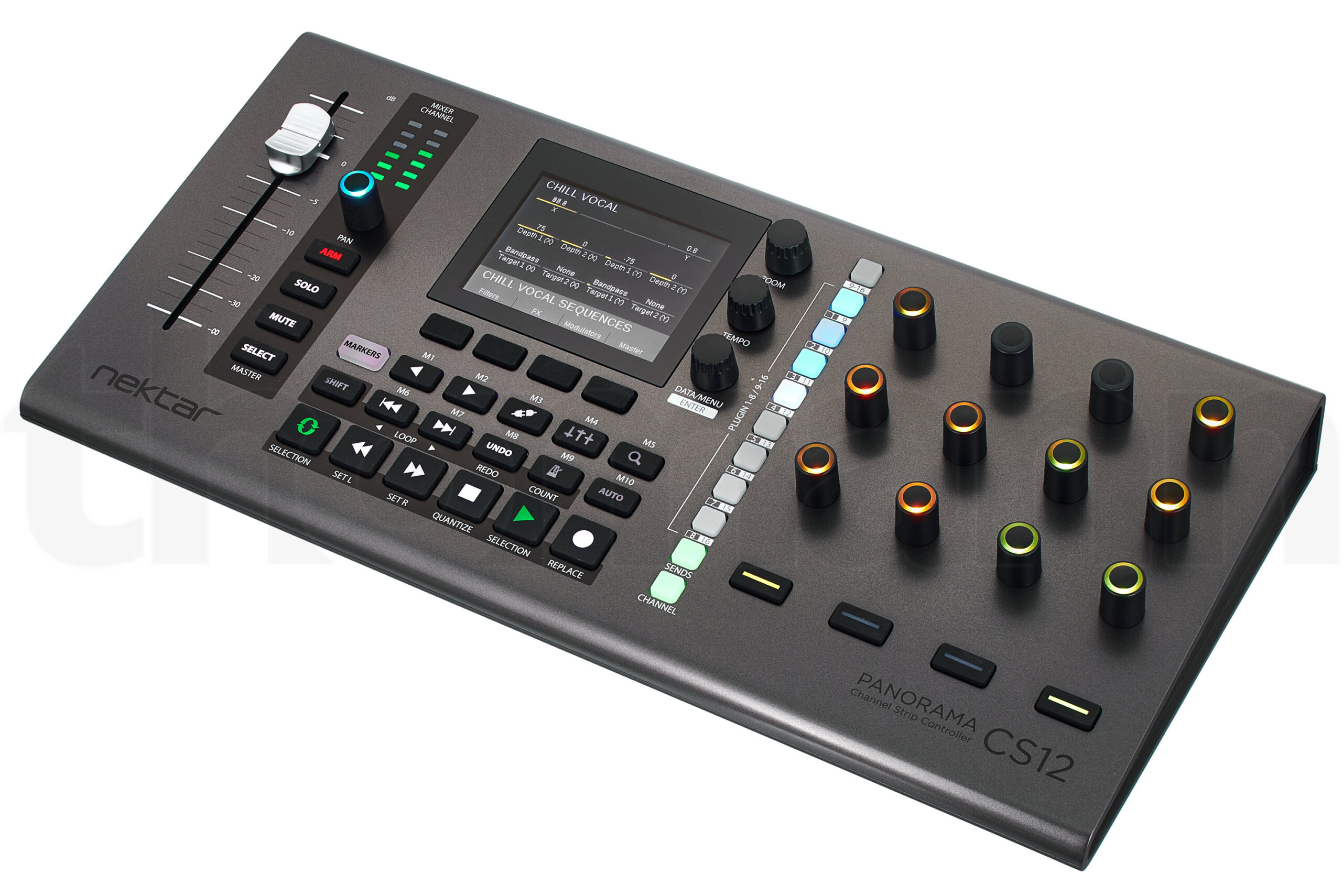
The Nektar Panorama CS12 was developed from the ground up for Logic Pro — and you can tell. While other controllers aim to be universal and support Logic as one of many DAWs, the CS12 is specialized for Logic. The integration goes deeper than most competitors: Channel Strip, Smart Controls, Plugin Parameters, Transport — everything is immediately accessible without configuration.
The centerpiece is a motorized 100mm fader that automatically syncs with the selected channel. There are also 12 encoders with LED rings that directly control plugin parameters, as well as dedicated buttons for Solo, Mute, Record Arm, and Transport. Practically every plugin that supports automation in Logic works immediately with the CS12 — the parameters are automatically assigned.
The build quality of the CS12 makes a solid impression, even though the case is made of plastic and not metal. The RGB LEDs on the activated buttons and encoders make it easy to find the controls even in dark studio environments. For around €349, you get the controller with the deepest Logic Pro integration in this price range.
TECHNICAL SPECS
Manufacturer: Nektar
Fader: 1x 100mm motorized fader
Encoder: 12 rotary knobs with LED rings
Buttons: Dedicated buttons for Solo, Mute, Record Arm, Pan + Transport section
Display: LCD display for parameter names and values
DAW Support: Logic Pro, Cubase, Nuendo (dedicated integration)
Connection: USB (bus-powered)
Price: around €349
ARGUMENTS IN FAVOR
- The deepest Logic Pro integration in this price range — specifically developed for Logic
- Motorized 100mm fader automatically syncs with the selected channel
- 12 encoders with LED rings directly control plugin parameters without mapping
- Smart Controls, Channel Strip, and Transport immediately accessible
- RGB LEDs for good visibility in dark studios
- Bus-powered — no external power supply needed
- Automatic plugin parameter assignment for all plugins with automation support
NEGATIVE POINTS
- Only a single motorized fader — not ideal for multi-channel mixing
- Plastic case — doesn't feel quite as premium as the price might suggest
- Works only with Logic Pro, Cubase, and Nuendo — not a universal solution
- No MIDI keyboard integrated
WHO IS IT SUITABLE FOR?
The Panorama CS12 is the right choice for producers who work exclusively in Logic Pro and are looking for deep, configuration-free integration. Particularly interesting for those who work a lot with plugins and want to control their parameters directly on the controller without dealing with MIDI mapping.
Link: Thomann
5. Arturia KeyLab MK3 (61 keys) — Best Premium Keyboard
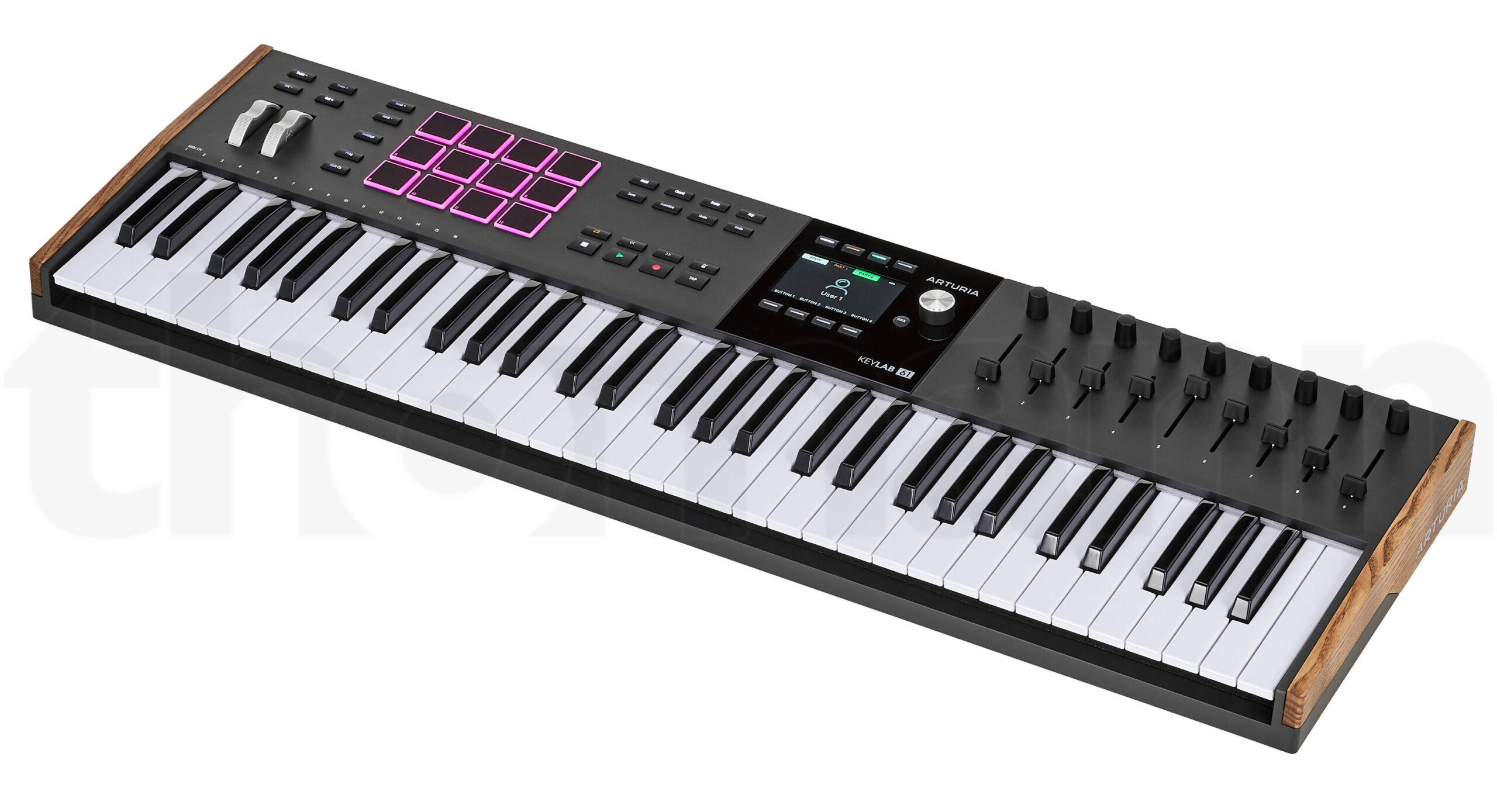
The Arturia KeyLab MK3 has become a true flagship keyboard in its third generation. The build quality is excellent, the design appealing, and the DAW integration has improved with every update. For Logic Pro users, Arturia offers dedicated scripts that allow seamless control of transport, mixer, plugins, and instruments after installation.
The 61 semi-weighted keys with aftertouch feel great to play — perfect for synth parts, pad sounds, and melodies. The 16 velocity-sensitive pads with polyphonic aftertouch are excellent for beatmaking and finger drumming. Plus, there are 9 motorized faders (a real standout feature in this class), 9 rotary knobs, and a large LCD display that shows parameter names and values in real-time.
The included software package is one of the most comprehensive on the market: Analog Lab Pro with thousands of sounds, Piano V, Augmented Strings, and more plugins. If you're looking for a high-quality keyboard that can also control the Logic Pro mixer and offers motorized faders, this is a package that's hard to beat.
TECHNICAL SPECS
Manufacturer: Arturia
Keys: 61 semi-weighted keys with aftertouch
Pads: 16 velocity-sensitive pads with polyphonic aftertouch
Fader: 9 motorized faders
Encoder: 9 touch-sensitive rotary knobs
Display: Large LCD display for parameters and navigation
Connections: USB-C, 5-pin MIDI In/Out, CV/Gate output, 4 pedal inputs
Included Software: Analog Lab Pro, Piano V, Augmented Strings, Rev Plate-140
Price: approx. €549 (61 keys)
ARGUMENTS IN FAVOR
- Motorized faders in a MIDI keyboard — rare and valuable combination
- Dedicated Logic Pro scripts for transport, mixer, and plugin control
- Excellent playing feel — semi-weighted keys with aftertouch
- 16 pads with polyphonic aftertouch for beatmaking
- Huge software bundle with Analog Lab Pro included
- CV/Gate output for analog synthesizers
- Beautiful, professional design and craftsmanship
NEGATIVE POINTS
- At approx. €549 not cheap — there are cheaper keyboards with a similar number of keys
- Logic integration requires downloading and installing a separate script
- Takes up a lot of desk space (61 keys)
- Needs an external power supply for the motorized faders
WHO IS IT SUITABLE FOR?
The KeyLab MK3 is the right choice for keyboardists and producers who expect a high-quality playing feel and want to control their Logic Pro mix on the controller at the same time. The motorized faders set it apart from the competition. The included software package also makes getting started particularly attractive.
Link: Thomann
6. PreSonus FaderPort 8 — Best Mixing Controller for Mid-Range Budgets
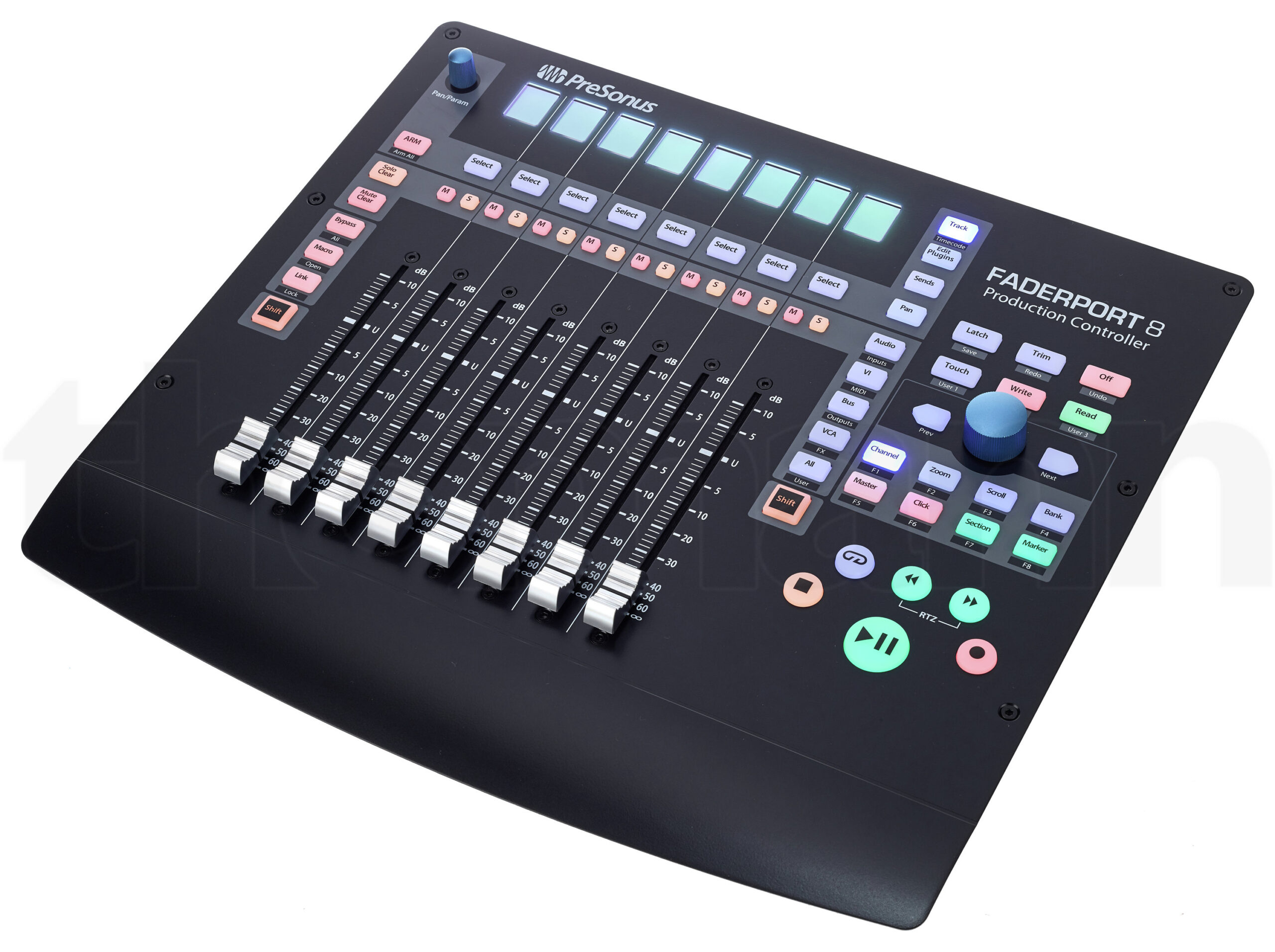
The PreSonus FaderPort 8 hits the sweet spot between the single fader of the Nektar CS12 and the professional SSL console. 8 motorized, touch-sensitive 100mm faders give you physical control over 8 channels simultaneously — enough for most mixing situations. The faders move automatically with the project, which makes a huge difference when mixing.
Logic Pro automatically recognizes the FaderPort 8 via the Mackie Control Protocol (MCU). Transport, fader, mute, solo, and channel selection work immediately. Each channel has a scribble strip display showing the channel name. The session navigator allows for quick scrolling through large projects. For around €499, you get a solid mixing tool that noticeably speeds up the workflow when mixing in Logic.
Compared to the significantly more expensive SSL UF8, the FaderPort 8 lacks high-resolution OLED displays and the ability to expand to 32 channels. But for producers looking for a dedicated mixing tool without investing four figures, the FaderPort 8 is an excellent choice.
TECHNICAL SPECS
Manufacturer: PreSonus
Fader: 8x 100mm motorized, touch-sensitive faders
Buttons: Solo, Mute, Select per channel + transport section
Display: Scribble strips (channel names) for each channel
Modes: Level, Pan, Send, Plugin
Protocol: Mackie Control (MCU) and HUI
DAW Support: Optimized for Studio One, compatible with Logic Pro, Cubase, Pro Tools, and more
Special features: Session Navigator for quick navigation
Connection: USB (bus-powered)
Price: ca. 499€
ARGUMENTS IN FAVOR
- 8 motorized faders for a real mixing feel — a big step up from mouse mixing
- Touch-sensitive faders for automation write in Logic
- Scribble strips show channel names directly at the fader
- Session navigator for quick scrolling through large sessions
- Bus-powered — no external power supply needed
- Solid value for money for an 8-fader controller
NEGATIVE POINTS
- Scribble strips are smaller and lower resolution than on more expensive controllers
- Works best with Studio One — Logic integration via MCU is functional but not as deep
- No encoders for plugin parameters (only faders and buttons)
- No MIDI keyboard — pure mixing controller
WHO IS IT SUITABLE FOR?
For producers and mix engineers who want motorized faders without spending over €1,000. The FaderPort 8 is the right device if you regularly mix in Logic and finally want to leave mouse mixing behind. For mixing, it's a noticeable upgrade over static faders or pure encoder controllers.
Link: Thomann
7. Icon P1-M — Best mixing controller for the budget
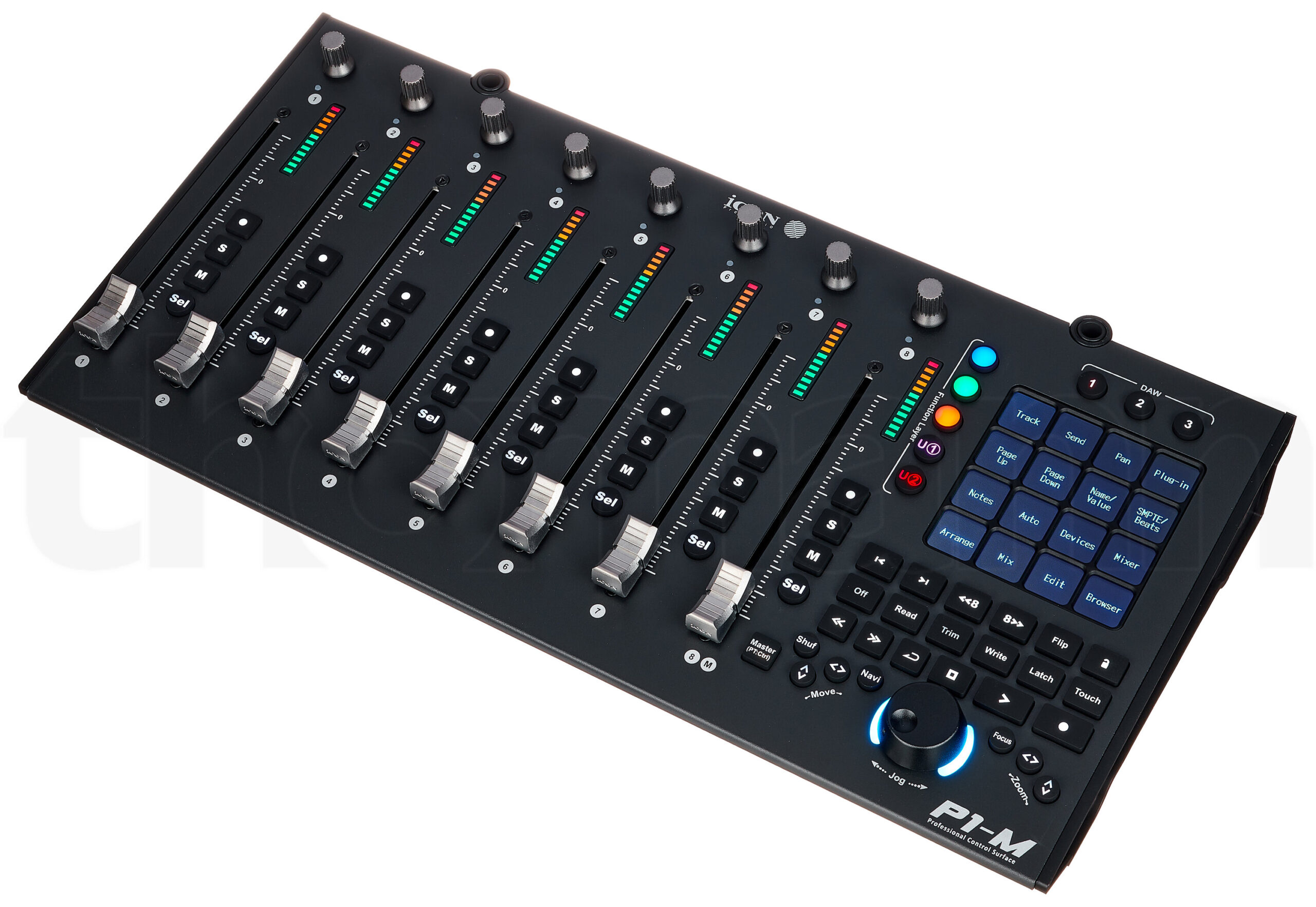
The Icon P1-M is Icon's current answer to the question of how much mixing controller you can get for around €555 — and the answer is: surprisingly a lot. 8 touch-sensitive motorized faders with 12-bit resolution, a 4-inch touchscreen with 80 programmable fields (16 fields on 5 layers), encoders, jog wheel, and illuminated buttons for record, solo, mute, and select per channel.
What sets the P1-M apart from other controllers in this price range is the 4-inch touchscreen, which serves as the central control unit. A total of 80 functions can be programmed over the 5 layers — this goes far beyond what you would normally expect from a controller of this size. For Logic Pro, the P1-M works via the Mackie Control Protocol (MCU) and HUI, providing solid integration for mixer control, transport, and basic plugin navigation.
A special feature: The P1-M can control up to 3 DAWs simultaneously. Those who work in Pro Tools or Cubase alongside Logic can switch between DAWs without having to unplug cables or reload profiles. The build quality is decent for the price, and the 12-bit fader resolution ensures precise level control.
TECHNICAL SPECS
Manufacturer: Icon Pro Audio
Fader: 8x touch-sensitive motorized faders (12-bit resolution)
Encoder: 8 rotary knobs
Display: 4-inch touchscreen with 16 programmable fields and 5 layers
Buttons: Illuminated buttons per channel (Rec, Solo, Mute, Select)
Navigation: Jog wheel
Protocol: Mackie Control, HUI
DAW control: Up to 3 DAWs simultaneously
Connection: USB
Price: approx. 555€
ARGUMENTS IN FAVOR
- 8 touch-sensitive motor faders with 12-bit resolution — very precise
- 4-inch touchscreen with 80 programmable functions over 5 layers
- Up to 3 DAWs can be controlled simultaneously — ideal for multi-DAW setups
- Jog wheel for quick navigation through the project
- Illuminated buttons per channel for Rec, Solo, Mute, and Select
- Solid price-performance ratio for motorized faders
NEGATIVE POINTS
- Logic integration via MCU is functional, but not as deep as with controllers with dedicated Logic scripts
- Build quality is decent, but not on SSL level
- Touchscreen menus take some getting used to
- No USB-C — still uses the older USB-B connection
WHO IS IT SUITABLE FOR?
The Icon P1-M is the right choice for Logic Pro users who want motorized faders and don't want to spend over 600€. The touchscreen and the 80 programmable functions offer significantly more flexibility than older MCU controllers. Particularly interesting for those who work in multiple DAWs simultaneously.
Link: Thomann
8. Behringer X-Touch Mini — Best Budget Controller
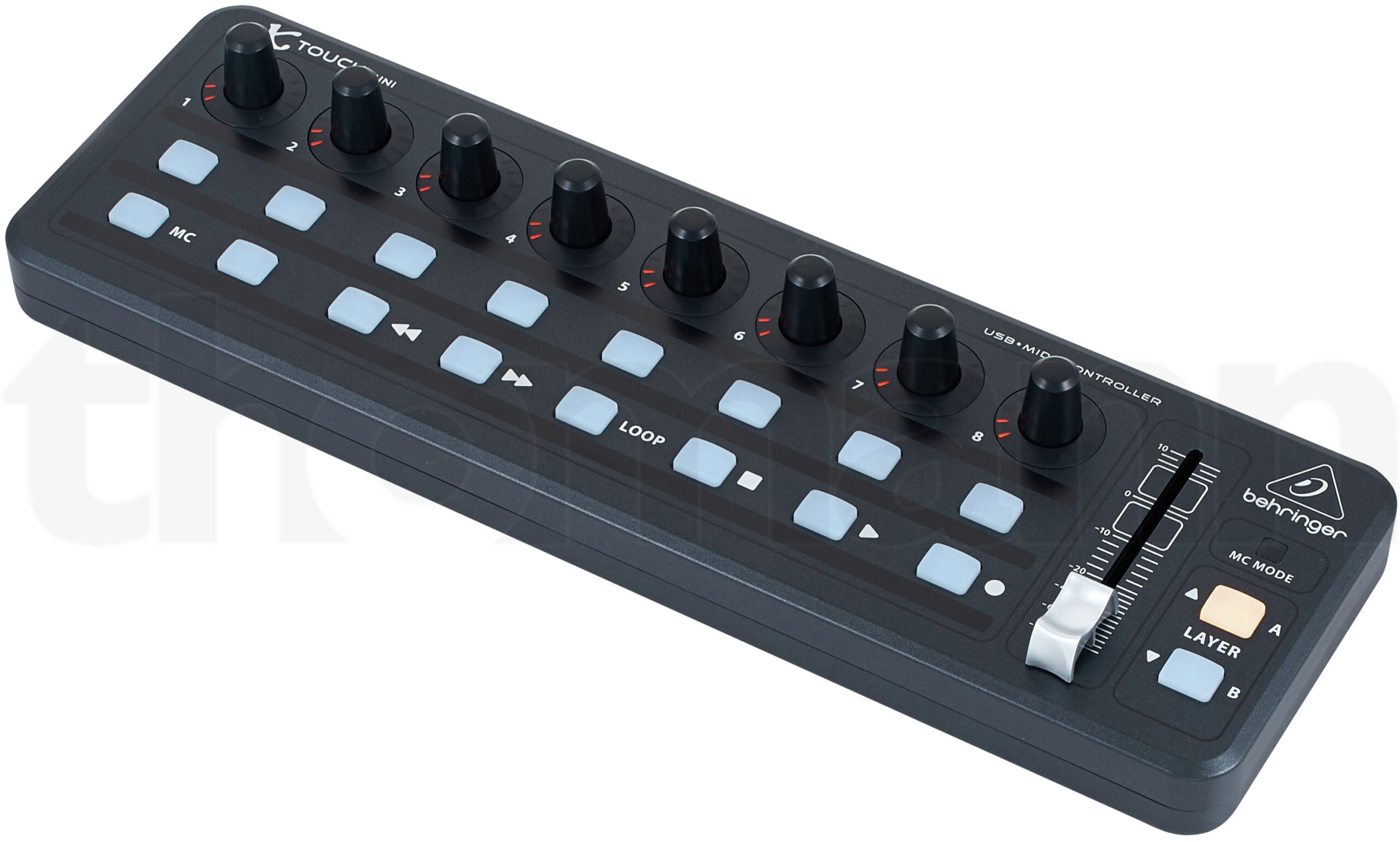
Sometimes you don't need motorized faders and an OLED display. Sometimes a few physical knobs are enough to avoid constantly clicking on tiny sliders with the mouse in Logic Pro. That's exactly what the Behringer X-Touch Mini is for — and it costs less than a nice dinner.
For about 65€, you get 16 illuminated buttons, 8 rotary knobs with LED rings, and a 60mm fader. It doesn't sound like much, but in practice, it's just the right amount of physical control that makes the difference. Thanks to Mackie Control Emulation, it works immediately with Logic Pro — transport, mixer, and basic channel control are directly available. The LED rings around the encoders show the current position, which greatly improves visual feedback.
The X-Touch Mini has two layers (A and B), effectively doubling the available controls. The device is extremely compact (32.5 x 10.2 cm), bus-powered, and weighs only 500g — it fits next to any setup and in any backpack. For the price, it's hard to beat.
TECHNICAL SPECS
Manufacturer: Behringer
Buttons: 16 illuminated buttons
Encoder: 8 rotary knobs with LED rings
Fader: 1x 60mm fader
Layer: 2 control layers (A/B)
Protocol: Mackie Control Emulation
Connection: USB (bus-powered)
Dimensions: 32.5 x 10.2 x 4.7 cm / 500g
Price: approx. 65€
ARGUMENTS IN FAVOR
- Incredible price-performance ratio — physical control for under 70€
- Extremely compact and lightweight — fits next to any setup
- Mackie Control Emulation = works immediately with Logic Pro
- LED rings on the encoders provide visual feedback on the current position
- 2 layers double the available controls
- Bus-powered — plug in and go
NEGATIVE POINTS
- Only a single small fader (60mm)
- No motorized faders — positions jump when switching layers
- No display — you can't see parameter names on the controller
- Build quality is... Behringer
WHO IS IT SUITABLE FOR?
For every Logic Pro user who wants physical control without spending a lot of money. Ideal as a complement to a MIDI keyboard or as a compact travel controller. If you just want to control a few plugin parameters or your mix faster, the X-Touch Mini is an absolute no-brainer.
Link: Thomann
9. Softube Console 1 MK3 — Best for channel strip workflow
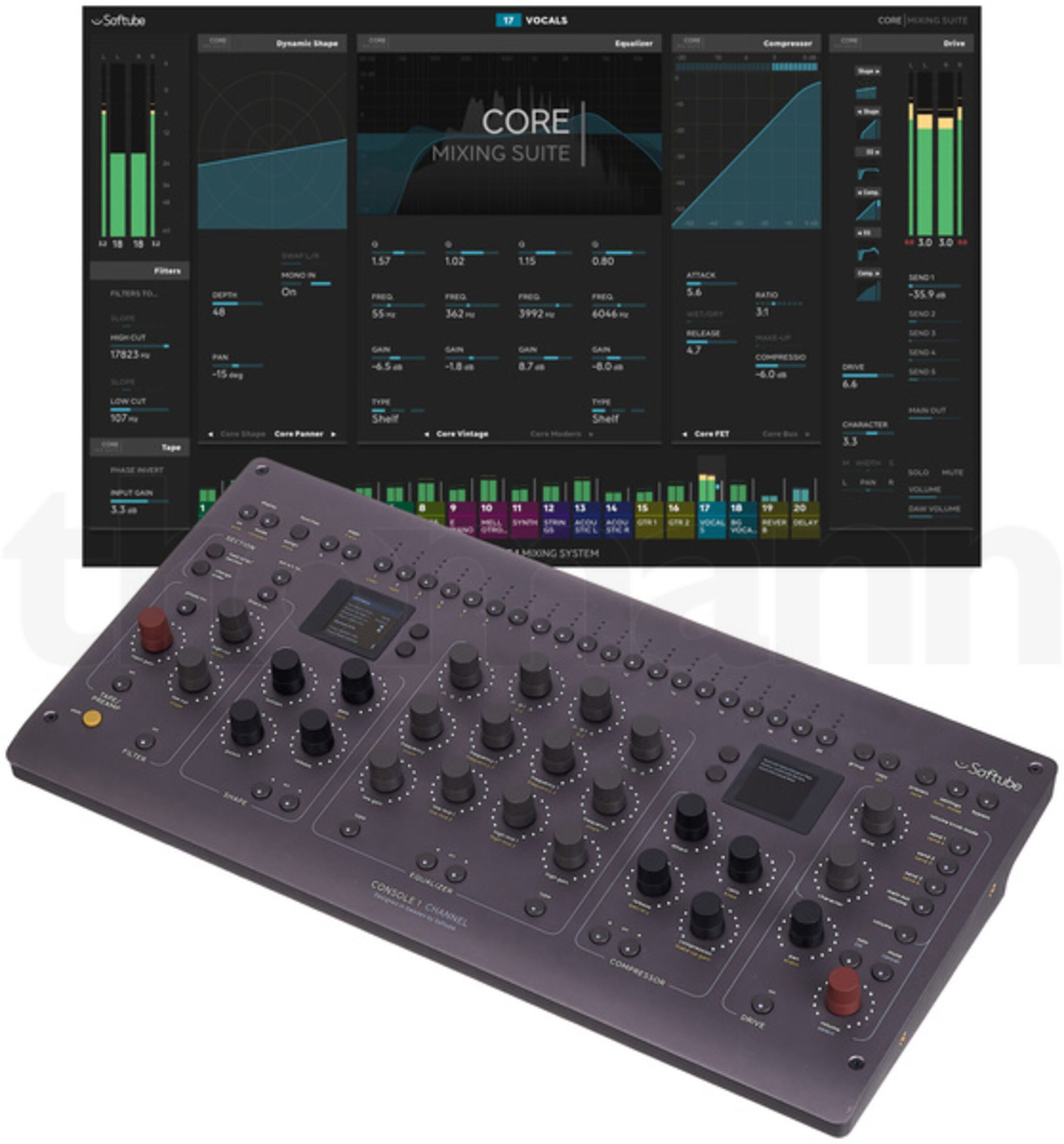
The Softube Console 1 takes a completely different approach than all other controllers in this comparison. Instead of faders and transport buttons, it offers a channel strip interface — with physical knobs for EQ, compressor, gate, volume, and pan that feel like the channel strip of an analog console. The concept: You select a channel, and all the knobs immediately show the settings of that channel.
Since Logic Pro 10.7, the Console 1 supports direct DAW control in Logic — volume, pan, sends, solo, and mute work without having to insert the Console 1 plugin. Added to this is the system's real strength: The included SSL-emulated channel strip software, which runs as a plugin on each channel and directly controls the physical knobs. Anyone who likes to mix like on an analog console — channel by channel, with real knobs for each sound processing — gets a unique experience here.
The Console 1 is not suitable for everyone. The channel strip metaphor works best if you're willing to fully embrace the Softube workflow. Those who primarily work with third-party plugins will find that the integration is less deep there. But for the price of around €499 (including SSL SL 4000 E Channel Strip Plugin), you get a system that can fundamentally change the mixing workflow in Logic.
TECHNICAL SPECS
Manufacturer: Softube
Controls: 20+ rotary knobs and buttons for EQ, compressor, gate, volume, pan
Concept: Channel strip controller — a channel strip interface for all channels
Display: None (all parameters are directly represented by the knobs)
DAW Support: Logic Pro (from 10.7), Pro Tools, Ableton Live, Cubase, Studio One, Luna
Included Software: SSL SL 4000 E Channel Strip Plugin
Connection: USB (bus-powered)
Price: ca. 499€
ARGUMENTS IN FAVOR
- Unique channel strip workflow — feels like mixing on an analog console
- Direct DAW control in Logic Pro from version 10.7
- High-quality SSL SL 4000 E emulation included
- Physical knobs for EQ, compressor, gate — no mouse clicking while mixing
- Compact design — takes up less space than a fader controller
- Bus-powered — plug in and go
- Expandable with Console 1 Fader for motorized fader control
NEGATIVE POINTS
- Requires willingness to fully embrace the Softube workflow
- Integration with third-party plugins is less deep than with Softube's own
- No display — you have to rely on the physical knob positions and the DAW view
- No faders for classic multi-channel mixing (available separately as Console 1 Fader)
- Occasionally known bugs with certain plugin displays in Logic
WHO IS IT SUITABLE FOR?
The Console 1 is the right choice for mix engineers who miss the workflow of an analog console and are ready to dive into the Softube ecosystem. If you mix channel by channel and want real knobs for EQ and compressor at your fingertips, you'll get a system here that feels fundamentally different from any other controller on this list.
Link: Thomann
Comparison table: All 9 controllers at a glance
| Controller | Type | Fader/Encoder | Display | Logic Integration | Price | Best for | Link |
|---|---|---|---|---|---|---|---|
| Auriteq Flow | Plugin Controller | 4 Encoders + 10 LCD Buttons | Touchscreen | Native | ~179€ | Plugin Workflow & Mixing | — |
| Novation Launchkey MK4 | Keyboard + Controller | 9 Faders + 8 Encoders | OLED | Dedicated Scripts | ~219€ | All-rounder | Thomann |
| SSL UF8 | Mixing controller | 8 Motor Faders + V-Pots | OLED per Channel | Dedicated Layer | ~1.099€ | Premium Mixing | Thomann |
| Nektar Panorama CS12 | Channel Strip Controller | 1 Motor Fader + 12 Encoders | LCD | Specially for Logic | ~349€ | Logic-specific | Thomann |
| Arturia KeyLab MK3 | Keyboard + Controller | 9 Motor Faders + 9 Encoders | LCD | Dedicated Scripts | ~549€ | Premium Keyboard | Thomann |
| PreSonus FaderPort 8 | Mixing controller | 8 Motor Faders | Scribble strips | MCU | ~499€ | Mixing (mid-budget) | Thomann |
| Icon P1-M | Mixing controller | 8 Motor Faders + 8 Encoders | 4″ Touchscreen | MCU/HUI | ~555€ | Mixing (Budget) | Thomann |
| Behringer X-Touch Mini | Compact controller | 1 fader + 8 encoders | — | MCU | ~65€ | Budget | Thomann |
| Softube Console 1 MK3 | Channel Strip Controller | 20+ knobs | — | Direct DAW control | ~499€ | Console workflow | Thomann |
Which Logic Pro controller suits you?
The selection is large, but the decision ultimately depends on your specific workflow. Here are our recommendations by use case:
Do you want plugin control and faster mixing? The Auriteq Flow combines automatic plugin mapping, metering, and mixer control in a compact device — and all for under 200€. Hard to beat.
Need an all-rounder with a keyboard? The Novation Launchkey MK4 is our top recommendation. Keyboard, pads, faders, and encoders in one device — and the Logic integration is excellent.
You regularly mix large projects and want the best? The SSL UF8 is the most professional mixing tool in this comparison. Motorized SSL faders, OLED displays, and expandable to 32 channels.
You work exclusively in Logic and want maximum integration? The Nektar Panorama CS12 was specifically built for Logic Pro and offers the deepest integration without configuration effort.
You're a keyboardist and want a premium instrument? The Arturia KeyLab MK3 combines excellent playability with motorized faders and a huge software bundle.
You want motorized faders without spending a fortune? The PreSonus FaderPort 8 (499€) or the Icon P1-M (555€) offer real motorized fader mixing at reasonable prices.
You want to get a feel for it first without investing too much? The Behringer X-Touch Mini gives you physical control for under 70€. A risk-free entry.
You miss the feel of an analog console? The Softube Console 1 brings back the channel strip workflow — with real knobs for EQ, compressor, and gate.
Conclusion
Logic Pro offers excellent support for external controllers — from the universal Mackie Control Protocol to dedicated integrations from individual manufacturers. Whether you want to spend 65€ or over 1,000€: A physical controller makes producing and mixing in Logic faster, more intuitive, and just more fun. And that's what counts at the end of the day.
2Our tip: Try out the controllers if possible beforehand — for example at Thomann or your local music store. How the faders feel, how fast the feedback is, whether the knobs are the right size for your fingers — that's individual. You can't really judge the feel in any review in the world. Only your own hands can tell you which controller is the right one.


 English
  German
  French
  Dutch
Dutch  Spanish
  Portuguese